


A growth strategy may involve entering new markets, expanding production, and scaling the business. However, delivering on such plans depends not only on investment and technology, but also on whether the company’s operating model can turn strategic goals into everyday work.
This matters especially during an ERP transformation, which involves not just implementing a new system but also changing processes, the allocation of responsibilities, and how departments work together. According to Panorama Consulting Group’s 2026 report, fewer than a quarter of the organizations surveyed paid significant attention to organizational change management. This underscores the importance of looking beyond the technology side of a transformation and considering whether the company is ready to change the way it works.
Using the case of a European industrial equipment manufacturer, we will examine how the gap between strategy and operational reality complicates ERP transformation, business process management, and production scaling.
Strategic goals and prerequisites for ERP transformation
The European industrial equipment manufacturer planned to expand its geographic footprint, enter new markets, and increase its production capacity. In the longer term, the company also aimed to develop a holding structure. To carry out these plans, it needed to bring order to its internal processes: formalize them, align approaches across departments, standardize operations, and optimize the company’s work.
The operating model developed at the parent company was meant to become the foundation for scaling. It was then to be rolled out at other production sites, so that approaches to organizing work would be consistent as the business grew.
Specifics of the manufacturing company’s business model
The company designs, manufactures, and delivers industrial equipment to customer orders. Most orders involve several different types of products. The company regarded its manufacturing business as project-driven. At the same time, its organizational structure remained functional: expertise, requirements, process ownership, and tools were concentrated in separate departments.
Each project requires a particular set of materials, equipment, components, and human resources. How these resources are used, and how much of them is needed, changes depending on the stage of order fulfillment. Effective production management therefore required coordinated work planning, resource provisioning, and execution control throughout the entire life cycle of every project.
IT environment and data management
The company’s digital environment consisted of several software solutions that were only partially integrated or not connected to one another at all. As a result, collecting, reconciling, and analyzing operational and financial data relied heavily on manual work.
This setup made it harder to obtain consistent information about the company’s performance and created additional difficulties for planning and monitoring results.
Why scaling required end-to-end business process management
Increasing production capacity did not, by itself, guarantee that the business would scale successfully. The company also needed a repeatable approach to managing customer orders, one that covered all the departments involved.
While an order was being fulfilled, its parameters could change, and with them the need for materials, equipment, and human resources. Information and management decisions therefore had to stay aligned across departments throughout the entire process. Without end-to-end business process management, it would be harder to replicate this model at new production sites.
ERP implementation as the foundation for scaling the operating model
To carry out its strategy, the company planned an ERP transformation at its main operating company, with the next step being to extend the resulting business process model to other production sites.
The ERP initiative was thus tied not only to the development of IT systems but also to the task of building an operating model that could be replicated consistently as the business grew.
Business process analysis: What the study revealed
The analysis showed that the way the company organized its work did not fully match the project-based nature of its production. This affected interaction between departments, resource planning, and end-to-end management of customer orders:
- Project-based business model and functional management structure: the company regarded its manufacturing business as project-driven. At the same time, its organizational structure remained functional: expertise, requirements, process ownership, and working tools were concentrated in separate departments.
- Formalization and end-to-end management of business processes: processes were partially formalized within individual departments, but there was no end-to-end description of processes covering the full sequence of actions across functions. As a result, coordinating the work of departments within a single customer order required additional effort.
- Resource planning and cost control throughout the order life cycle: the planning, monitoring, and recording of personnel labor costs within individual projects were not carried out consistently throughout the entire life cycle of an order. This affected the interrelated tasks of project management, use of human resources, and monitoring of work execution.
For example, when manufacturing equipment for a customer, the company needs to assign tasks to employees, determine the time required, and monitor actual labor costs. If these activities are not linked at every stage, it is harder to compare planned work with work actually completed and to assess how many resources were spent on a specific order.
- The role of project managers in planning and execution control: the company had project manager roles, but their duties were mostly limited to coordination, approvals, and reporting. There was also no integrated process for managing plans, from preparing templates and developing plans to approving them and monitoring their execution. The formal presence of project management therefore did not provide a full cycle of order planning and control.
- Order-to-Cash, an end-to-end process from order to payment: the company’s key end-to-end business process was Order-to-Cash, the cycle running from handling a customer order to shipping the products and completing the related financial settlements.
The diagram below conceptually reconstructs the model of this process as it stood at the time of the analysis:
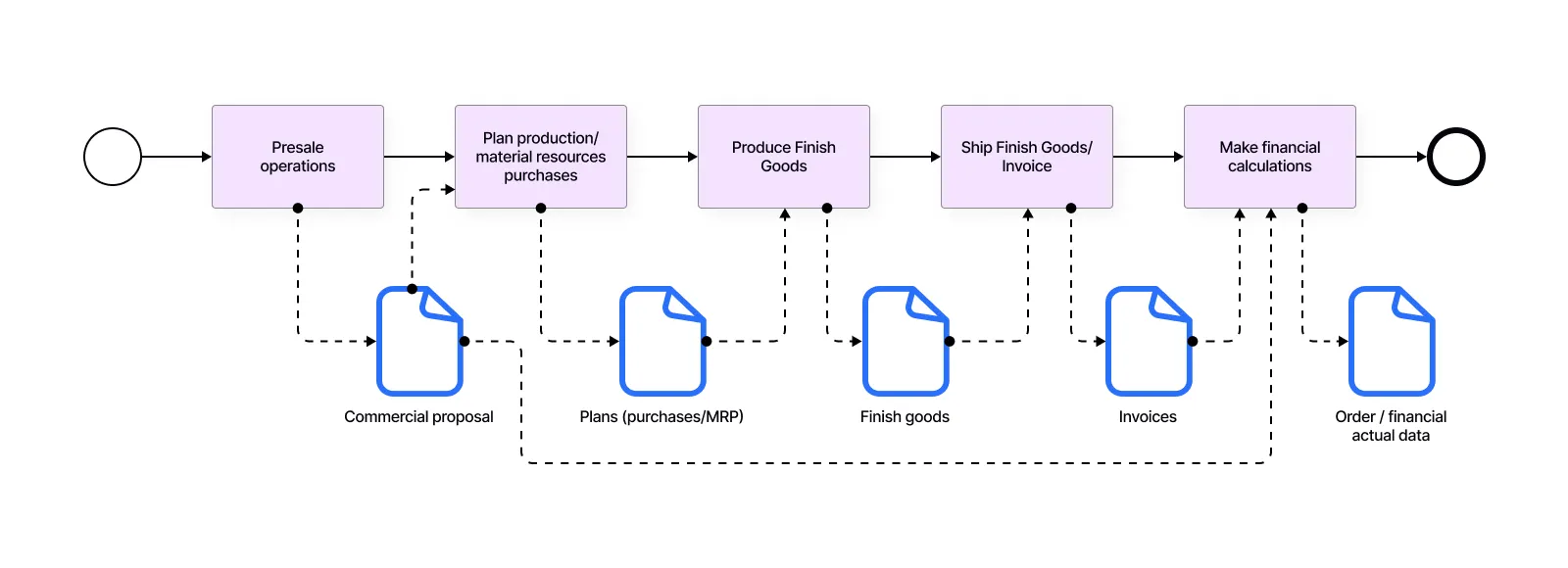
Note to the diagram: the image is a conceptual reconstruction of the end-to-end process as it operated at the time. The company has not confirmed the model as a complete, end-to-end process.
Each of the sub-processes shown included lower-level processes and specific operations. The main workflow also depended on supporting processes, in particular shift management and human resources management.
Order fulfillment depended not only on core production operations. For work to proceed as planned, the company also had to coordinate shift schedules, employee availability, and staffing needs at different stages of production.
Because individual functions operated in different systems, it was difficult for the company to plan the fulfillment of a specific order and to monitor its operational and financial results across the entire cycle.
Similar difficulties arose when consolidating information on the order portfolio, both at the level of the individual company and at the holding level. This made comprehensive planning and analysis of results across the full set of orders more difficult.
From analyzing current processes to a target model
The analysis of business processes based on data about how they were actually performed ran into significant difficulties. The company had no end-to-end process owner, departments had a limited view of how adjacent functions worked, and there was no documented description of the processes that would have helped clarify how individual stages of work are connected and how they are carried out in practice.
Based on meetings with representatives of various functional departments and the information gathered from them, a model of the current process was reconstructed at a mid-level of detail. Some sub-processes, however, still needed clarification.
A target process model and the corresponding IT architecture were also prepared for further discussion.
Target operating model for business process management
The proposed model for managing the Order-to-Cash process involved moving from coordinating separate functions to end-to-end management of customer orders:
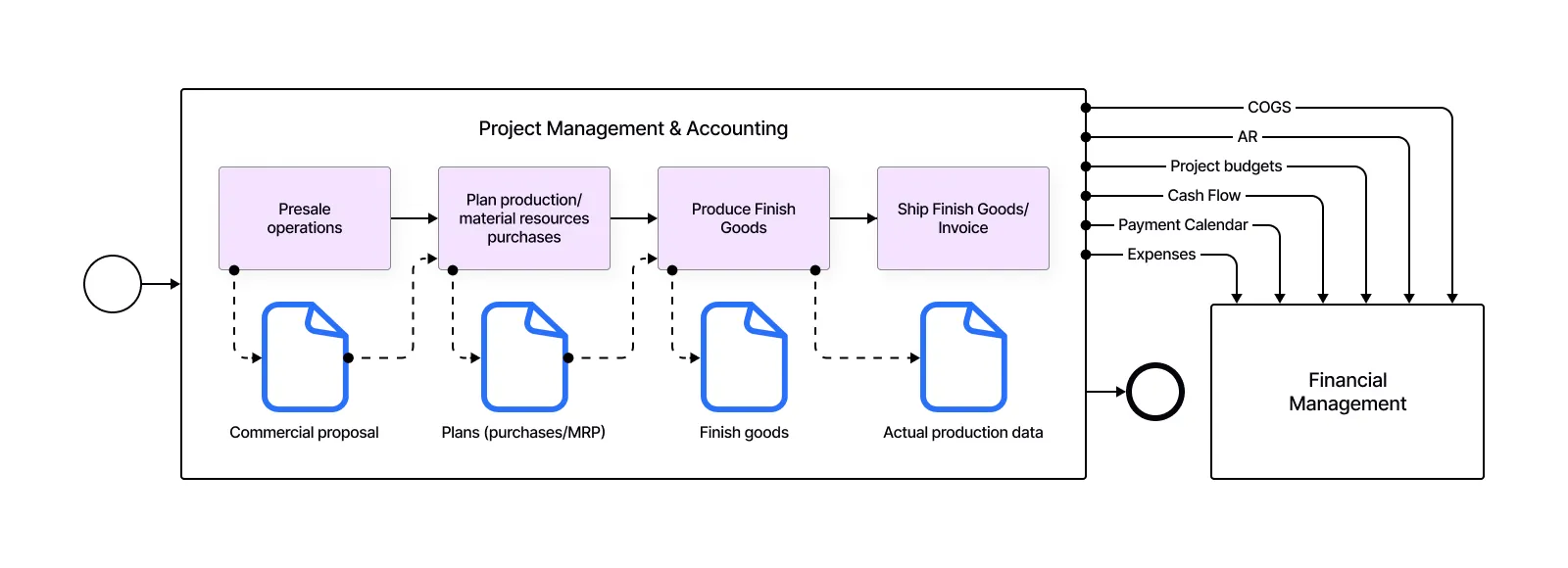
The proposed customer order management model: from production planning to shipment and financial accounting.
Project management as the order control center
In the target operating model, project management was to coordinate the work of different functional departments and ensure consistent actions throughout the entire customer order fulfillment cycle.
At the same time, the role of project management was not to be limited to coordination, approvals, and reporting. Instead, it was to support work planning, tracking of resources used, and execution control at every stage, from preparing the order through to completing production and shipping the products.
Order portfolio management and resource planning
The target model also provided for managing the overall portfolio of projects, that is, the company’s customer orders. This was meant to create a basis for planning production capacity, staffing needs, cash flows, and costs, as well as for analyzing order profitability.
To achieve this, information had to be available at different levels of detail: by components and operations within an order, individual orders, groups of orders, customers, and periods. This approach was intended to support analysis not only within a single company but also at the holding level.
As a result, the target operating model was meant to connect the fulfillment of individual orders with the company’s overall resource planning and financial analysis.
Why the ERP transformation did not move toward end-to-end process management
At one meeting, both the reconstructed model of the current business processes and the proposed target model, together with the corresponding IT architecture, were presented. However, the participants on the client’s side were unable to meaningfully confirm these models, make corrections to them, or reject the proposed approach.
Department heads could assess processes within their own functional areas, but they did not regard the end-to-end process as their own area of responsibility. The company had no one with the authority to confirm the description of the current process, resolve issues at the interfaces between departments, and ensure that work on the target model continued.
As a result, work on the end-to-end process could not be continued, including further analysis of the end-to-end business process and its interdependencies between departments. Meanwhile, the ERP implementation went on: individual modules were implemented locally within the relevant departments, without continued work on a unified model of end-to-end business processes.
Conclusions: Why ERP transformation requires end-to-end management
- The operating model must support strategic goals: this case shows how the specifics of current work organization can stand in the way of strategic plans. If existing business processes make it harder to scale production, changing the operating model may become not just part of the ERP implementation but one of the company’s strategic tasks.
- Changes to business processes require coordination across functions: an end-to-end process covers not only a sequence of operations but also people, tools, information, and decision-making rules. A change to one element may therefore require revisiting others: the allocation of responsibilities, working tools, and the ways departments interact. An ERP transformation requires coordinated changes across all of these components.
- Siloed processes make it harder to scale the business: when each department organizes its work mostly within its own boundaries, the company becomes more dependent on individual employees, and the risk of errors and extra coordination costs grows at the interfaces between functions. Processes that are not aligned with one another are also harder to replicate at other production sites, which can slow down business scaling.
The company’s strategic goal remained business expansion. However, the existing operating model made it harder to scale production, made it more expensive and time-consuming, and increased the risks.
None of this means that functional departments are unnecessary: their specialized expertise remains important. The problem was the absence of end-to-end management that would bring the work of these departments together within shared business processes.
In this case, the gap between functional work organization and end-to-end management became apparent in the customer order fulfillment process, from the order to the completion of related operations. But the same problem can arise in any business process that requires several departments to work in a coordinated way.
How SMART business helps companies go through ERP transformation
This case demonstrates challenges that are important to consider even before an ERP system is implemented. A technology solution on its own does not close the gaps between departments, does not designate those responsible for end-to-end processes, and does not guarantee that management decisions will be consistent. At the same time, an ERP system provides a technological foundation for comprehensive business management: it brings data together in a single information environment, automates operations, makes processes transparent, and makes it possible to monitor resources and results. To make full use of these capabilities, it is important to align the system’s functionality with the company’s business processes, goals, and management model. This requires systematic analysis, a clear understanding of business goals, and a readiness to manage change across the entire organization.
The SMART business team treats ERP implementation as a comprehensive project that covers not only system configuration but also business process analysis and modeling, requirements definition, integration design, and implementation planning. This approach helps identify organizational and technological risks, align expectations, and build a consistent transformation plan that takes the company’s specifics into account.
At the same time, every business has its own processes, constraints, and goals, so there is no ready-made, universal scenario for ERP transformation. The implementation partner’s task is to help the company make sense of its current situation, set priorities, and find a well-founded path to the target operating model.
Planning an ERP implementation or scaling an existing system? Request a consultation, and the SMART business team will help you assess your current processes, define key requirements, and plan the steps of your ERP transformation.
Author: Vlad Berezin, Business Development Manager, SMART business