


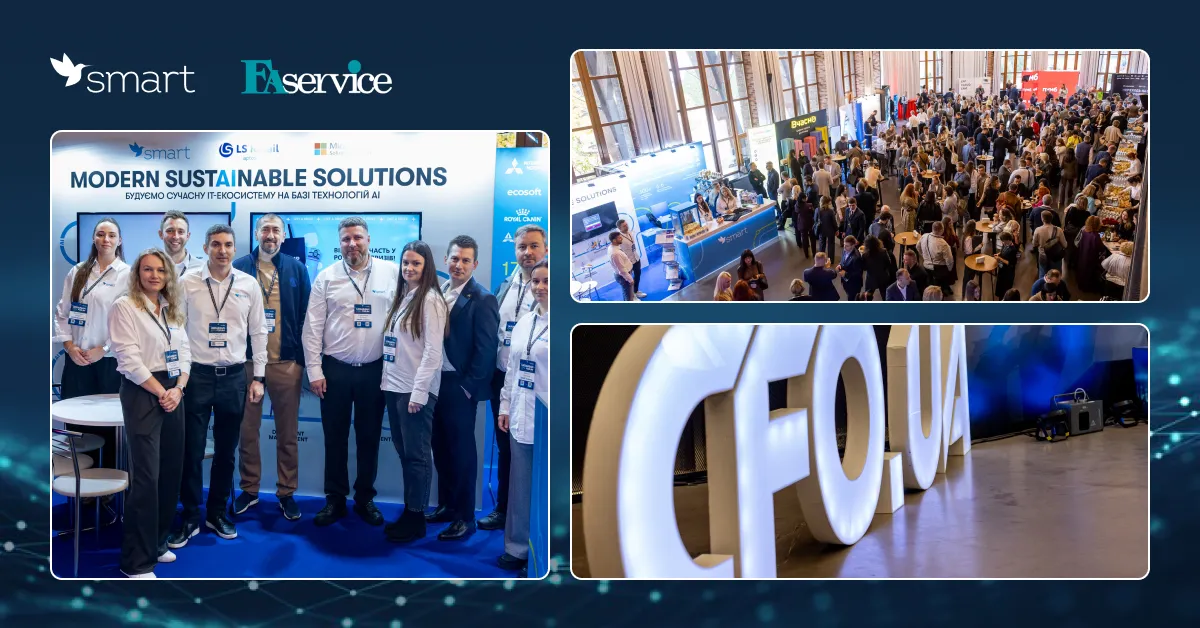
On October 22–23, 2026, Kyiv hosted the 24th Ukrainian CFO Forum, organized by FAService. This year, the event brought together 717 business representatives, including CFOs, CEOs, company owners, bankers, and investors. Over two days, more than 50 speakers and moderators took part in 22 presentations, dialogues, and panel discussions on management decisions amid wartime risks, limited access to capital, and an unstable operating environment.
The focus was on financial resilience, liquidity management, development financing, asset recovery, business model adaptation, and assessing the economic impact of technology adoption. The digital transformation of the finance function, accounting automation, ERP systems, and the practical use of artificial intelligence also received special attention. Participants not only discussed current challenges but also shared the experience of companies that are looking for solutions and are already implementing them to operate in the new reality.
SMART business joined the forum as an AI-driven IT ecosystem partner. For the team, it was an opportunity not only to share expertise in automation and digital transformation, but also to exchange experience with finance leaders, discuss companies’ practical needs, and better understand which technology solutions businesses require to improve efficiency, keep control over their processes, and adapt to new challenges.
The forum also featured SMART business clients, Automagistral-Pivden and MTI, who shared their practical experience and presented cases on ERP transformation and preparation for SAF-T UA reporting. In this article, we have gathered the main topics and takeaways of the forum, the companies’ experience, and the SMART business team’s impressions of two intense days.
Practical Experience of SMART business clients: ERP transformation and preparation for SAF-T UA
One of the key parts of the forum was practical cases from companies that are already implementing technology solutions to make their businesses more manageable and their financial processes more efficient.
Automagistral-Pivden: How to unite complex business processes in a single ERP System
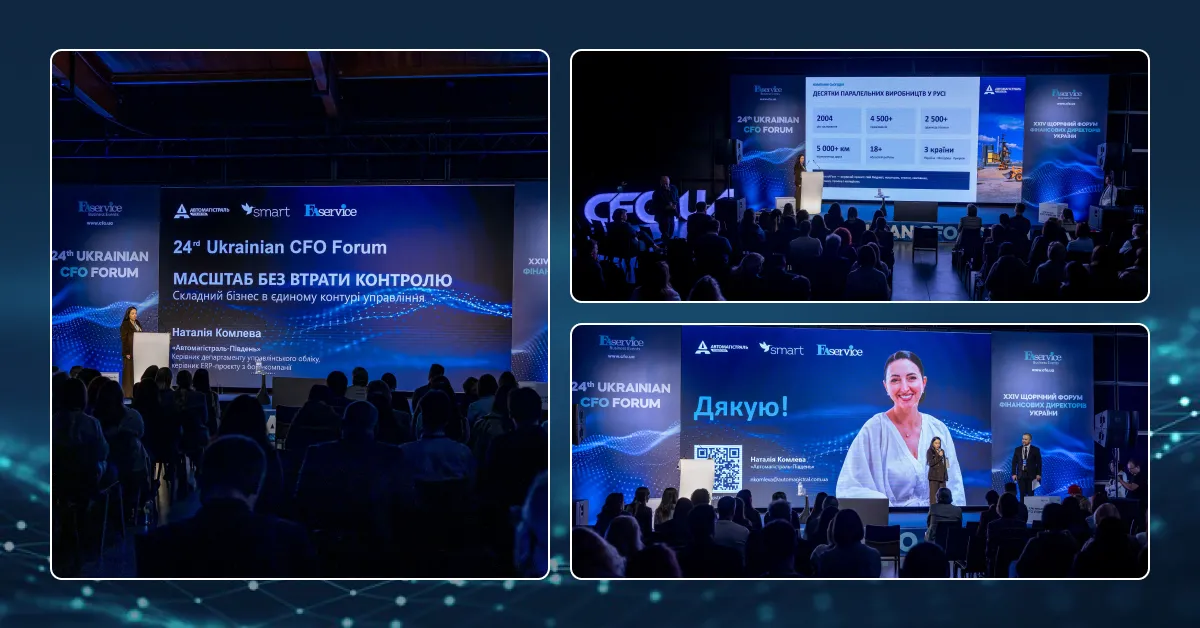
On October 22, Nataliia Komleva, Head of the Management Accounting Department at Automagistral-Pivden, delivered a presentation titled “Scale Without Losing Control: A Complex Business Within a Single Management Framework.” Using the company as an example, the speaker showed how business scaling and a more complex operational structure change the requirements for a management system.
For a large infrastructure business that runs numerous projects at once and manages production, logistics, and service processes, disconnected systems make data exchange and coordination between departments harder. This puts additional strain on management accounting and prevents a complete picture of the company’s performance. Together with SMART business, Automagistral-Pivden implemented the Microsoft Dynamics 365 Business Central ERP system, which brought key processes together in a single digital environment. In the system, financial and management accounting, construction, procurement, logistics, and transport are interconnected. In addition, digital tools for foremen, drivers, and mechanics are used to support operations.
The case demonstrated how a single ERP system helps align the work of different departments, ensure data interoperability, and maintain control over financial and operational processes as the company grows. You can read more about the Automagistral-Pivden case on the SMART business blog.
MTI: SAF-T UA as a quality check of accounting data
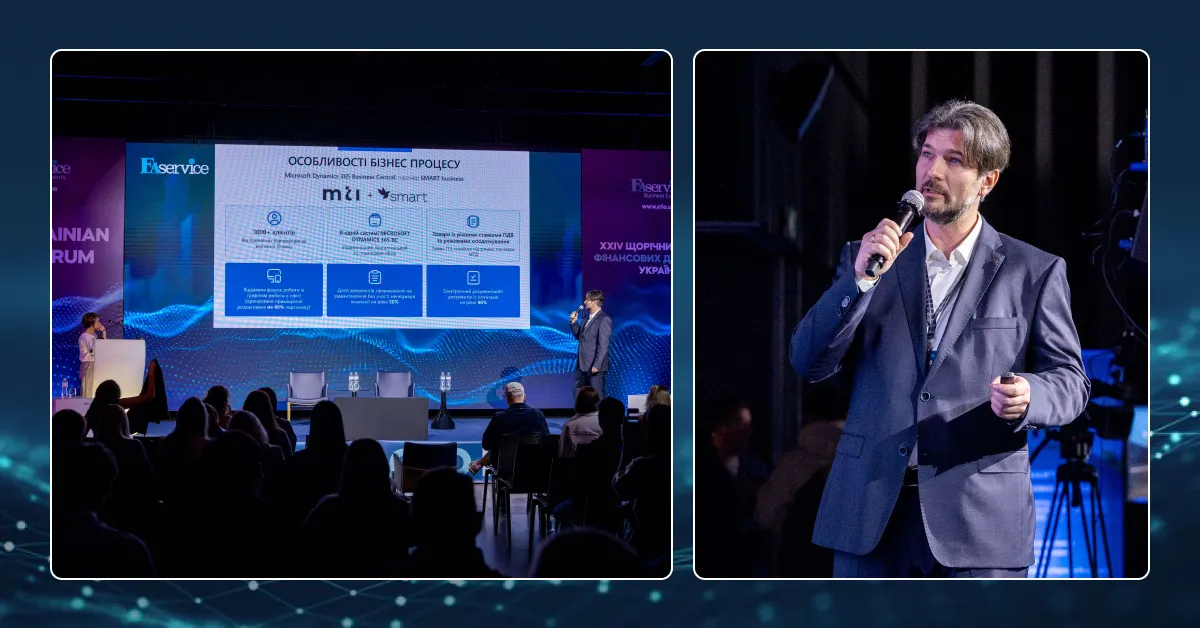
On October 23, Ruslan Andriichuk, CFO of MTI hi-tech distribution, delivered a presentation titled “SAF-T UA as a Stress Test for the Finance Function: What the CFO Should See Before the Tax Authorities Do.” He described the company’s experience of preparing for the new reporting requirements.
One of the most challenging stages was working with historical accounting data: the team had to identify and correct errors, adapt to changes in the requirements and format versions, and re-verify the data after corrections. The case showed that readiness for SAF-T UA depends not only on the ability to generate a report, but also on data quality, the structure of accounting, and the coordinated work of the finance, accounting, and IT teams.
To automate the process, MTI uses the SMART SAF-T UA solution. It enables the company to generate a SAF-T UA file in about 5 minutes after receiving a request, validate the data, and detect errors before the report is submitted.
Summing up MTI’s experience, Ruslan Andriichuk stressed that preparation for SAF-T UA should start in advance, without waiting for a request from the State Tax Service. Timely verification of historical data and accounting system settings helps assess the company’s readiness for reporting and avoid a rush when preparing the file.
What else was discussed at Ukrainian CFO Forum 2026
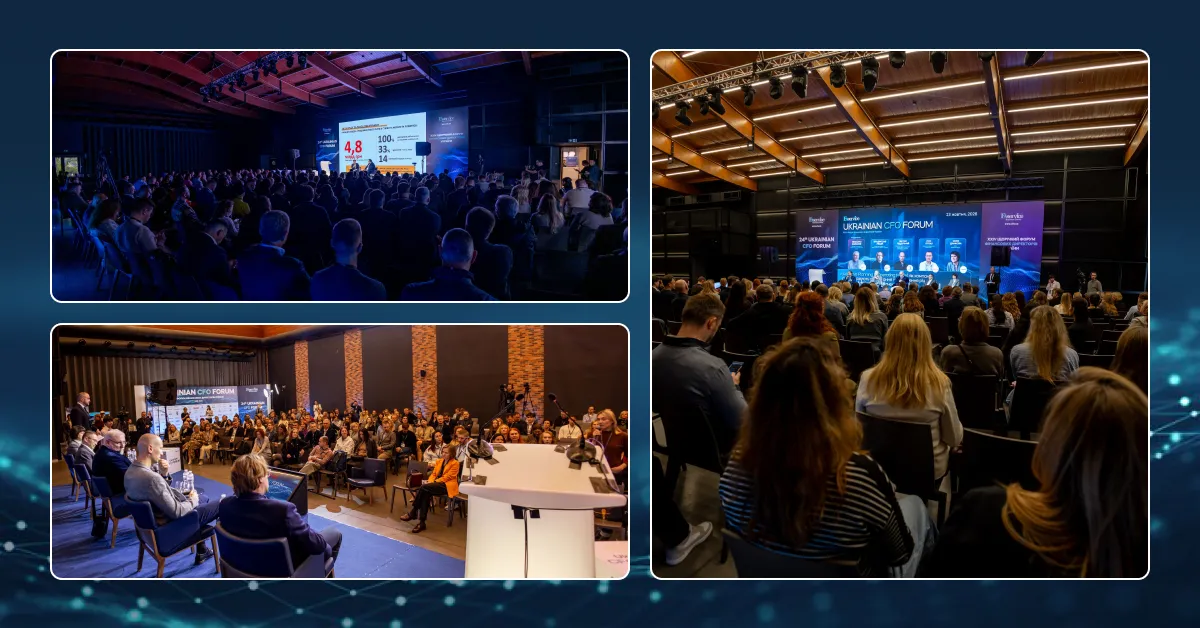
Beyond the cases of SMART business clients, the forum program covered a range of other topics important to finance leaders. Participants not only discussed challenges but also shared practical approaches to planning, asset management, and improving business efficiency.
- Economic outlook and financial benchmarks for 2027. Serhii Nikolaichuk, First Deputy Governor of the National Bank of Ukraine, and Andrii Dligach, founder of Advanter Group, examined the conditions under which the Ukrainian economy could develop and how the current situation affects companies’ financial decisions. The topics discussed included access to lending, the cost of raising funds, and currency restrictions. Different estimates of future GDP dynamics were also presented: according to the NBU’s July forecast, growth may reach 1.7% in 2026 and 3% in 2027, while Andrii Dligach gave his own estimate of 0.5% for 2027. Participants also highlighted the risks to the economy and business posed by the continuation of the war, as well as the share of companies (69.5%) that factor a prolonged war into their scenarios. It is worth noting that these figures and estimates were stated by the speakers and do not constitute a single agreed forecast.
- Adaptive planning under uncertainty. Representatives of British American Tobacco Ukraine, Danone, FOXTROT, and Metinvest Group examined different approaches to planning. In particular, Danone uses monthly rolling forecasting over an 18-month horizon, FOXTROT combines a three-year strategic horizon with triggers for revising operational forecasts, and Metinvest Group relies on a baseline scenario, reserves, and plan revisions after external shocks. British American Tobacco Ukraine shared its experience of moving to an alternative operating model after damage to its production facilities.
- Asset recovery and business model restructuring. Representatives of Nova Poshta, VARUS, Biosphere, and Starlight Media discussed repeat investments, decentralization of warehouse infrastructure, asset losses, and the transformation of revenue sources. Examples included VARUS’s assessment of the costs and benefits of a distributed warehouse network, and Starlight Media, where digital revenue tripled and changes that had previously been planned over 7–10 years were implemented in 2–3 years.
- Finding operational efficiency reserves. A panel on hidden EBITDA examined how reviewing production and tax processes helps cut costs without additional capital investment. In particular, Kansai Helios Ukraine presented the results of optimizing its processes: lead time fell from 7.7 to 2.6 days, the service level rose to 93%, and savings exceeded $100,000 in capital investments thanks to a review of production processes. The forum also featured the example of TAS Association, where the digitalization of tax processes saved UAH 35 million over two years.
- AI and digital transformation of the finance function. Speakers discussed the use of AI assistants, task automation, and the integration of corporate systems, as well as how to assess the real impact of technology: through productivity, data accuracy, operating costs, and process speed.
- The new role of the CFO in working with the CEO and teams. Separate discussions focused on the distribution of management responsibility, the CFO’s involvement in strategic decisions, risk management, and supporting teams under prolonged strain.
Overall, the discussions showed that the finance function increasingly goes beyond budget and reporting control. The CFO is one of the key participants in strategic management, from investment assessment and operating model restructuring to digital transformation and the search for new sources of efficiency.
SMART business at Ukrainian CFO Forum 2026: Expert conversations and live meetings
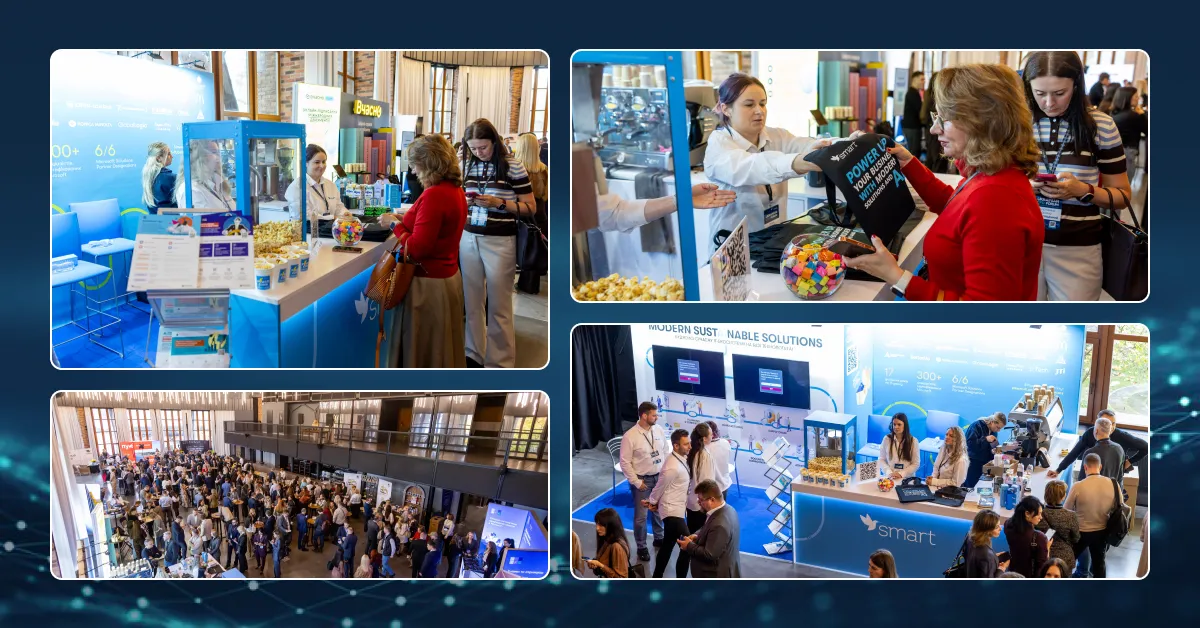
For SMART business, the main value of taking part in the forum was the chance to talk directly with business representatives, exchange experience, and better understand their current challenges and digital transformation plans. Over two intense days, these meetings made it possible not only to share expertise but also to discuss the practical potential of technology for automating processes and improving company efficiency. At the SMART business booth, participants could discuss their accounting automation needs with the team over coffee, and in the prize draws they could win books on artificial intelligence and technology.
In the forum’s busy rhythm, every meeting with business representatives was valuable: hearing their current challenges and needs, sharing our own expertise, and discussing how to find technology approaches to specific problems together. The exchange was mutually beneficial: participants received practical recommendations, and the SMART business team gained a deeper understanding of the needs of finance leaders and companies in general.
Prepare your business for the challenges of 2027 with SMART business
The presentations and discussions at Ukrainian CFO Forum 2026 gave a clearer picture of what finance leaders and companies should prepare for in 2027. Key guideposts include more cautious investment planning that takes the cost of financing into account, tighter liquidity control, readiness to revise financial forecasts in response to external changes, the search for operational efficiency reserves, and asset recovery. At the same time, the role of high-quality data, finance process automation, and technology, including AI, will grow, and their impact should be measured through concrete business metrics.
This is the understanding with which the SMART business team returned from the forum: in 2027, it will be important for companies not just to adopt new technologies but to use them to build an integrated management system with aligned processes, reliable data, and the ability to respond quickly to change. ERP solutions, reporting automation, digitalization of the finance function, and AI tools can become a practical foundation for such a transformation.
So if you could not attend the event, or have already identified areas that need to change, the SMART business team is ready to help you find the right technology solutions. We have experience automating business processes and implementing ERP and other digital tools that help companies overcome operational challenges and carry out their development plans.
Request a consultation to discuss your company’s needs and determine which solutions will help strengthen your business and enter 2027 with confidence.